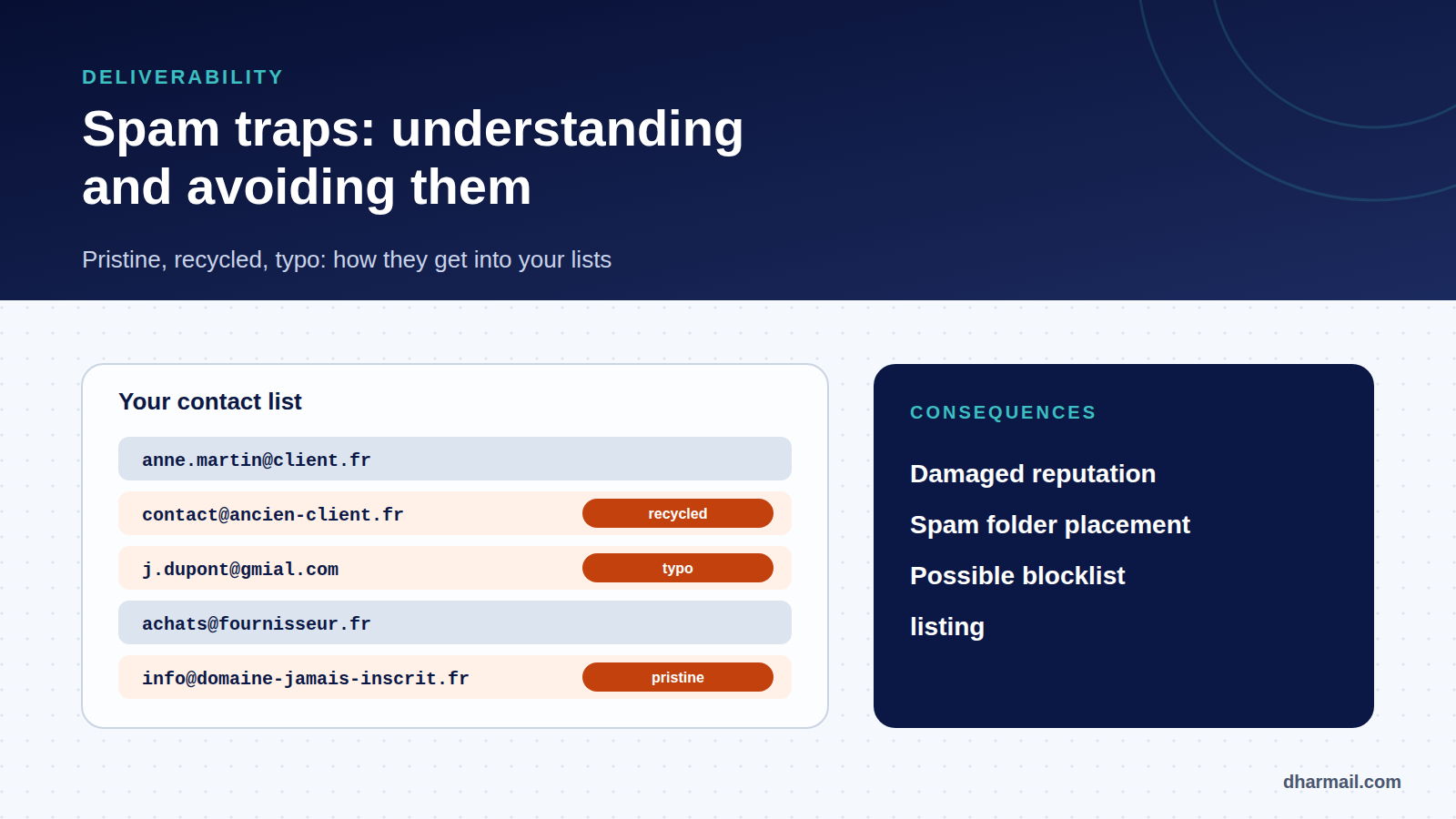
A spam trap is an email address that never asked to receive your messages. It reads nothing, clicks nothing and never complains. But every email it receives is recorded by its owner, which may be a blocklist or a major mailbox provider. To them, it is proof that the sender mails addresses it did not obtain properly.
It is one of the most effective, and least visible, mechanisms in email deliverability. You will never see a trap in your statistics: you will only see its consequences. Here is how they work, how they get into your lists and how to avoid them.
Key takeaway: spam traps are never published and cannot be reliably identified. The only effective protection happens at the source: no purchased lists, confirmed sign-ups, and removal of bounces and inactive contacts.
What is a spam trap?
Spamhaus broadly defines them as addresses that have not opted in to any email. Their owners never reveal them: a published trap would immediately become useless. They are run by blocklists, mailbox providers and reputation companies.
A trap does not measure your content quality. It measures how you collect and maintain your list. That is why it weighs so much: it goes straight to the question of consent.
The three main families of traps
Pristine traps
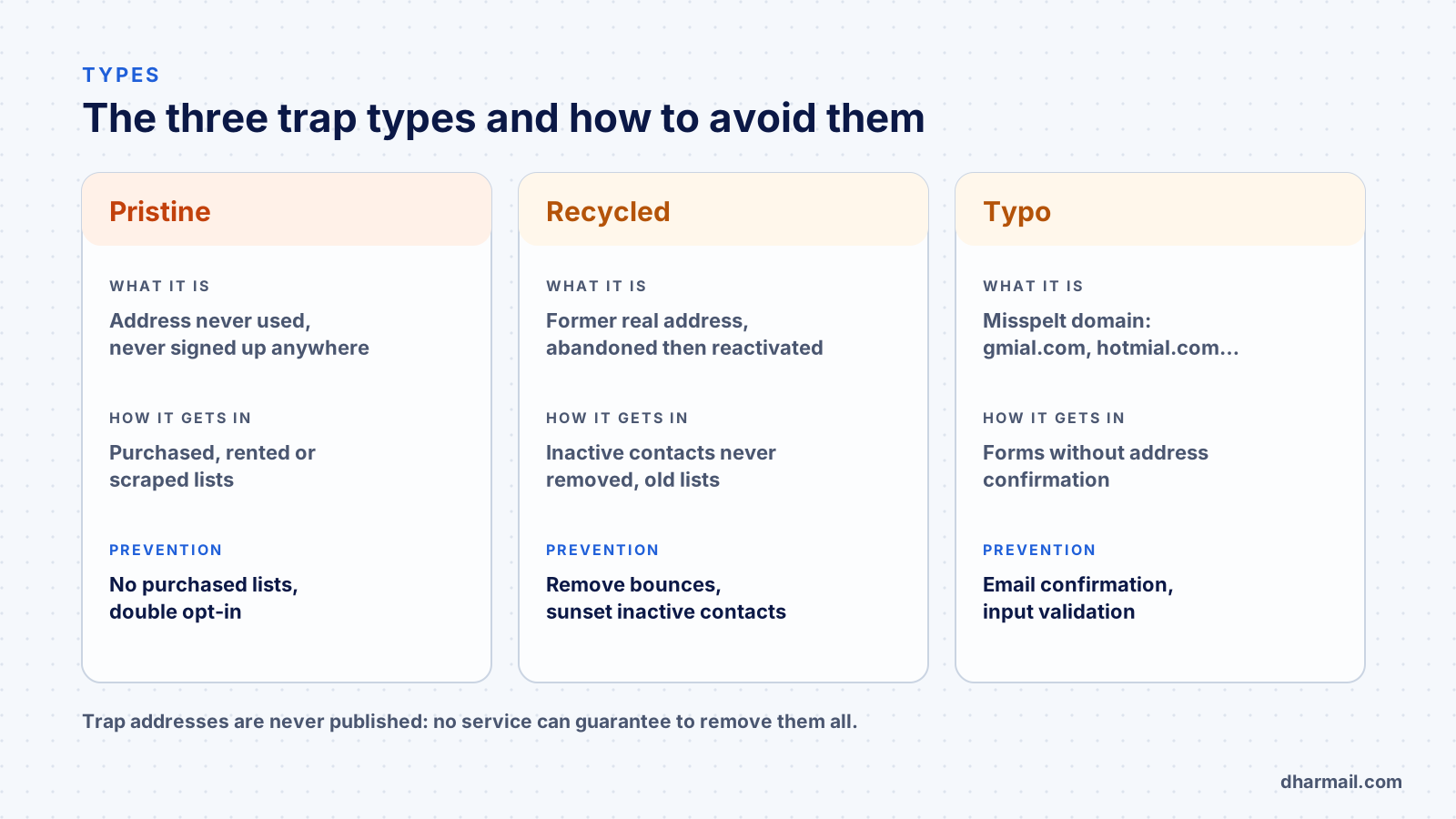
An address never used by a person and never signed up anywhere. It may be hidden on websites to lure address-harvesting bots. If it receives your email, your list contains harvested, purchased or rented addresses. It is the most serious signal.
Recycled traps
A former real address, abandoned by its owner, which first returned errors and was then reactivated as a trap after a long period. Validity cites about twelve months of inactivity as common practice, though it is not a published standard. If you still mail that address, you have not handled bounces and inactive contacts.
Typo traps
An address with a misspelt domain: gmial.com, hotmial.com, outllok.com. It enters your lists through a form that does not check the address. Validity considers them less serious than pristine traps, but they reveal unconfirmed collection.
What a trap costs you
Validity says traps weigh heavily in IP and domain reputation, and that some blocklists monitor trap activity to block senders that mail them. Possible consequences:
- spam folder placement of your messages at some providers;
- a blocklist listing, with rejections at every receiver that queries it;
- lasting damage to domain or IP reputation.
Spamhaus does not detail the exact role of traps in each of its lists. It does say its CSS list targets email showing signs of unsolicited sending and poor list hygiene, and that its listings generally expire three days after the last detection. Our guide to email blocklists explains how to check and get delisted.
Signs that you are hitting traps
Since traps are invisible, you spot them by their effects:
- a sudden blocklist listing;
- an unexplained drop in inbox placement at one or more providers;
- falling opens and clicks with no change in content;
- rising bounces, a sign of an ageing list.
A one-off send to an old “reactivated” list is the most classic scenario. Our article on warm-up explains why inactive contacts do not belong in a restart.
How to avoid spam traps
1. Never buy, rent or scrape addresses. It is almost the only source of pristine traps. Spamhaus regularly sees mail in its traps from lists presented as “verified”.
2. Confirm sign-ups (double opt-in). A confirmation email removes typos and fraudulent sign-ups. Spamhaus explicitly recommends it, and now requires it in its sender rules.
3. Remove hard bounces immediately. An address returning a permanent error today can become a recycled trap tomorrow. See hard bounces and soft bounces.
4. Set aside inactive contacts. After a targeted re-engagement attempt, remove or park contacts that have not reacted for a long time. Our article on B2B list quality covers this hygiene.
5. Check your forms. Format validation, detection of common typos on well-known domains, protection against automated sign-ups.
Can you “clean” traps out of a list?
Partly, and with no guarantee. Address verification services can remove some invalid addresses, obvious typos or non-existent domains. But Validity points out that traps are valid addresses: identifying them quickly is “next to impossible”, and no service can guarantee removing them all, especially pristine traps.
Spamhaus goes further: using a cleaning service to “wash” a non-consented list, removing traps and keeping the rest, is in its view an abusive practice. The problem is not the trap, it is the list.
FAQ
What is a spam trap?
An email address that never consented to receive messages, used by blocklists and providers to spot senders who collect or maintain their lists poorly.
Can I get a list of spam traps?
No. Their owners never publish them: a revealed address would become useless.
Can a single trap block my sending?
It depends on the list and volume, but a trap signals a collection or maintenance problem. Repeated hits often lead to a listing.
Is an email verification service enough?
No. It removes some invalid addresses and typos, but does not reliably detect pristine traps. Only consented, confirmed collection really protects you.
Are recycled traps less serious?
They are generally considered less serious than pristine traps, but they reveal unhandled bounces and inactive contacts.
Conclusion
Spam traps are not fought with a tool but with discipline: confirmed consent, no purchased lists, bounces removed, inactive contacts set aside. It is also what improves engagement and reputation. If your sending suffers a listing or an unexplained placement drop, Dharmail’s email deliverability audit (page in French) looks at list collection and maintenance as much as technical setup.