Deliverability problems are often blamed on content, SPF, DKIM or DMARC.
Those topics matter. A poorly authenticated domain, a badly built message or an inconsistent DMARC policy can obviously hurt results.
But in B2B, the real weakness is often elsewhere: the quality of the email list.
A degraded list means more bounces, more inactive contacts and more negative signals sent to Gmail, Microsoft and other mailbox providers.
And the penalty is well known: your emails arrive less reliably, your reputation drops, then one day even your legitimate messages start landing in spam.
An email list is a reputation asset
An email list is not just a marketing file.
It is a living asset that directly influences the trust given to your sends.
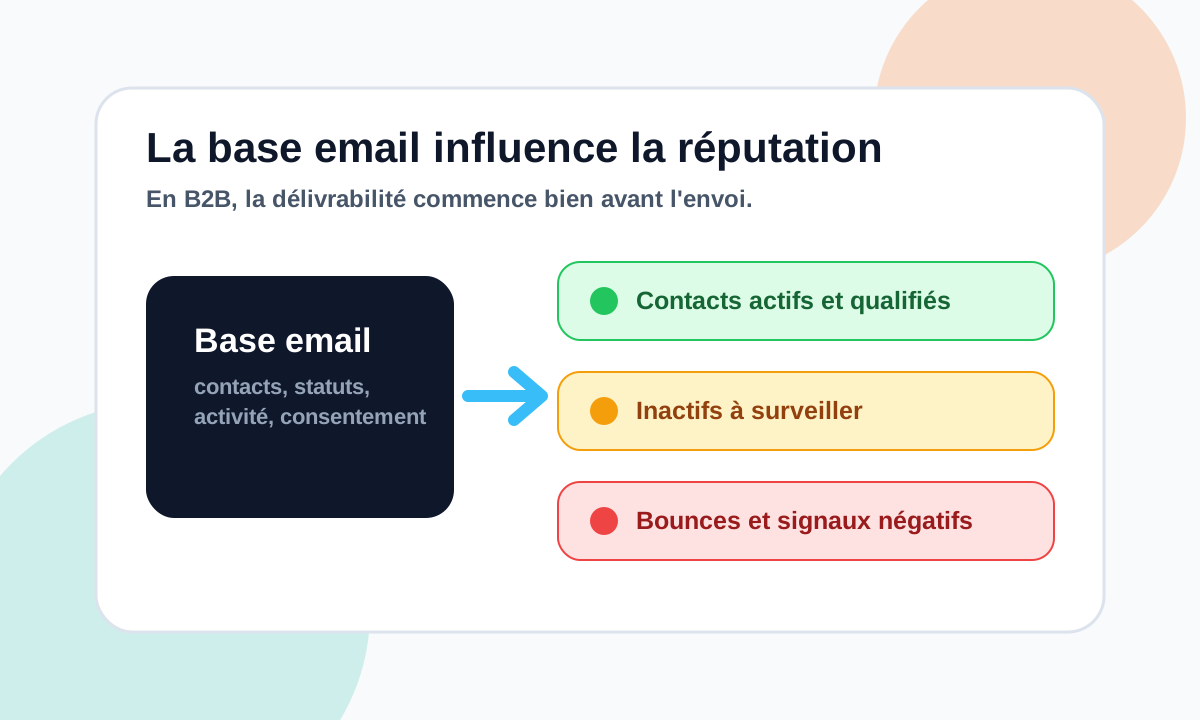
Every address, every bounce, every lack of engagement and every complaint builds a signal.
Mailbox providers do not only look at your DNS configuration. They also look at how recipients react to your emails:
- are messages opened?
- do recipients reply?
- do they click?
- do they systematically ignore the messages?
- do they report emails as unwanted?
- do many addresses no longer exist?
In short: the data you send to matters as much as the message you send.
Why a degraded list hurts deliverability
A degraded list sends negative signals continuously.
The problem is not just a few invalid addresses. The real issue is accumulation.
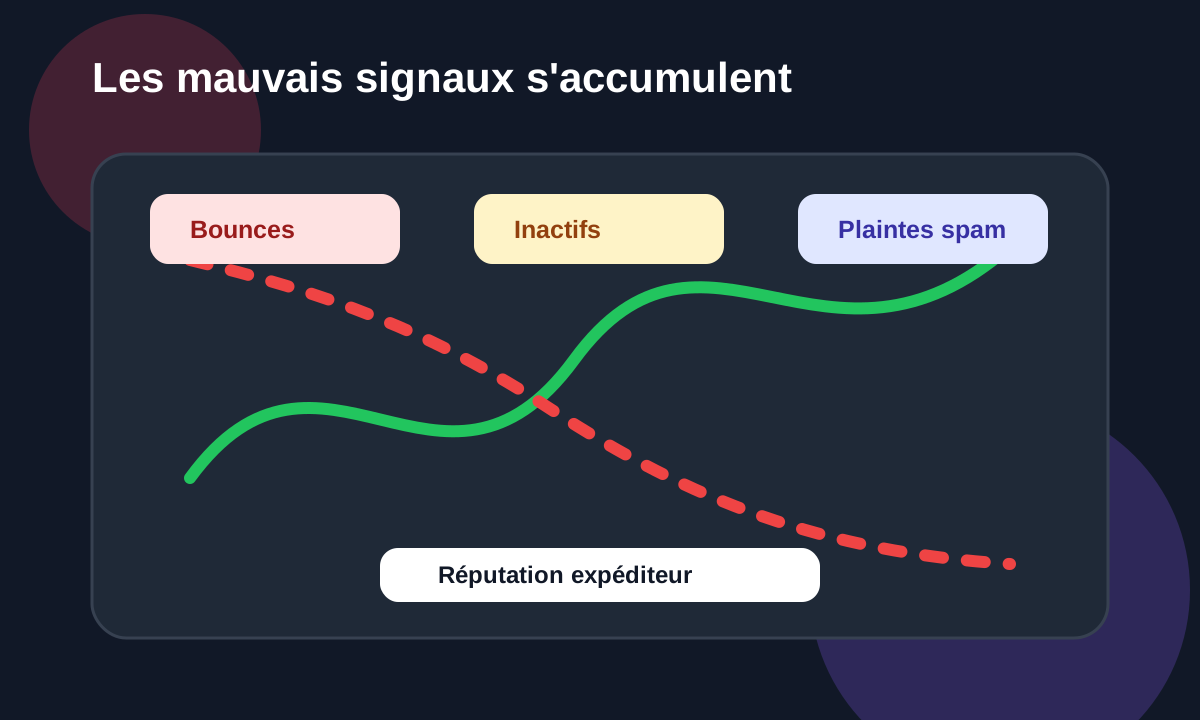
The main signals to watch:
Hard bounces
A hard bounce usually means an address does not exist, no longer exists, or cannot receive the message permanently.
If you keep sending to those addresses, you send a clear signal: the list is not maintained.
A high volume of hard bounces can lower the trust given to your campaigns, especially if it keeps happening. Our article on hard bounces and soft bounces explains how to tell them apart.
Inactive contacts
An inactive contact is not necessarily a bad contact. But if a large part of the list never reacts, it becomes a weak signal.
Mailbox providers observe engagement. An audience that massively ignores emails can contribute to worse inbox placement.
In B2B this is common: people change jobs, companies change domains, generic mailboxes are abandoned, contacts are no longer decision-makers.
Spam complaints
Complaints are among the most sensitive signals.
They can come from genuine disagreement, consent collected too long ago, excessive sending pressure, or simply a recipient who no longer recognises the relationship.
Even with perfectly configured SPF, DKIM and DMARC, a list that generates too many complaints eventually becomes a problem. See the impact of the Gmail spam complaint rate.
Deliverability starts before sending
Deliverability is not decided only when you click “send”.
It is decided well before:
- at collection;
- at qualification;
- during cleaning;
- in how inactive contacts are handled;
- in segmentation;
- in sending frequency;
- in the ability to remove bad addresses;
- in the rigour of CRM or marketing data.
An address collected without context, never revalidated, never engaged and contacted too late can become a risk.
Conversely, a smaller, better maintained and better segmented list can produce better signals than a large, poorly followed one.
What to clean regularly
List cleaning does not need to be spectacular. Above all, it must be regular.
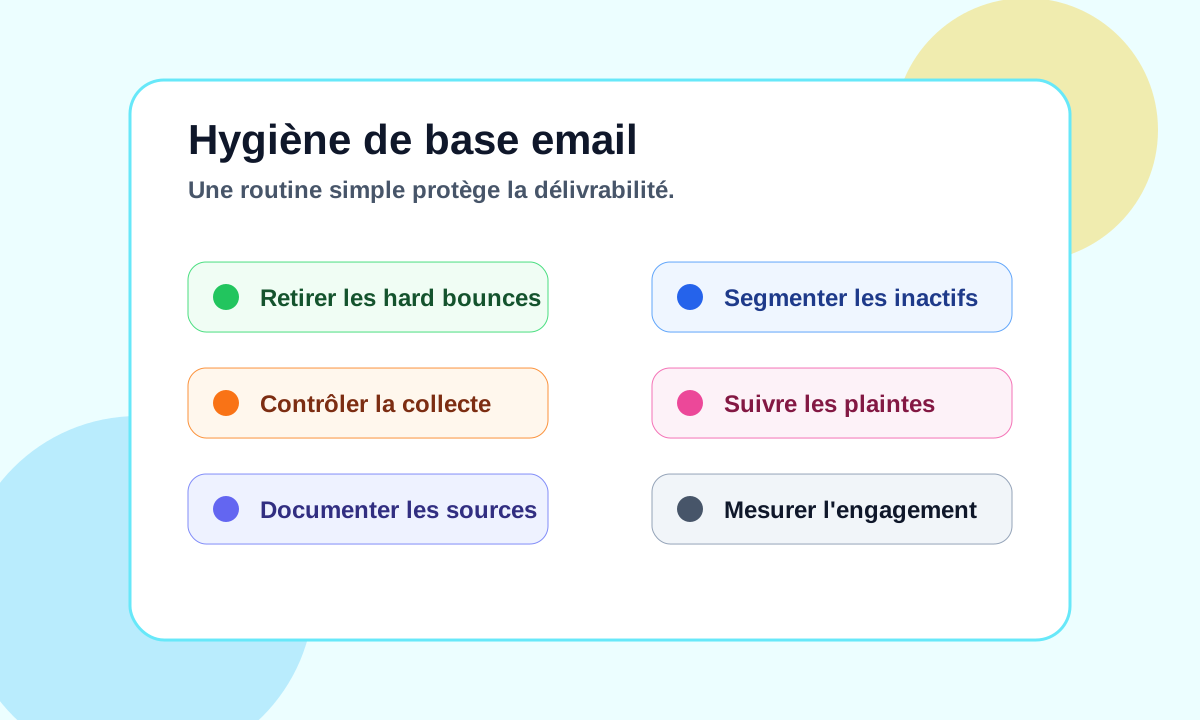
Basic good practices:
- remove hard bounces quickly;
- watch repeated soft bounces;
- segment inactive contacts;
- gradually reduce pressure on profiles that no longer react;
- distinguish customers, prospects, partners and cold contacts;
- document collection sources;
- avoid mixing very different lists;
- track spam complaints;
- measure engagement by mailbox provider;
- keep content, audience and frequency consistent.
This work may seem less technical than DMARC or DKIM. Yet it is often decisive.
The trap of old lists
In B2B, lists age quickly.
Employees change companies, domain names change, departments close, shared mailboxes are no longer read, contacts fall out of target.
A list that was fine two years ago may be fragile today.
The risk grows when that list is suddenly reactivated after a long period without contact.
For mailbox providers, it can look like suspicious behaviour: a sudden volume increase, many bounces, low engagement, complaints or quick deletions.
Restarting must therefore be gradual, much like an email warm-up.
Technical setup and data quality must move together
SPF, DKIM, DMARC, BIMI, the right headers and domain reputation remain essential.
But they do not make up for a degraded list.
A good technical setup proves the email is legitimate. It does not prove the message is expected, useful or sent to the right person.
That is why a serious approach to deliverability must connect two worlds:
- the technical side: DNS, authentication, reputation, routing, sending platform;
- the data side: collection, segmentation, engagement, hygiene, sales pressure.
When both dimensions are aligned, email becomes much more stable.
Conclusion
An email list is not just a marketing file.
It is a reputation asset.
Bad data can cost more than you think: lower reputation, emails in spam, lost sales visibility, legitimate messages received less reliably.
The good practice is simple: clean, segment, monitor and document.
In B2B deliverability, list quality is often the most underrated lever.
To assess technical setup and sending practices together, see Dharmail’s email deliverability audit (page in French).