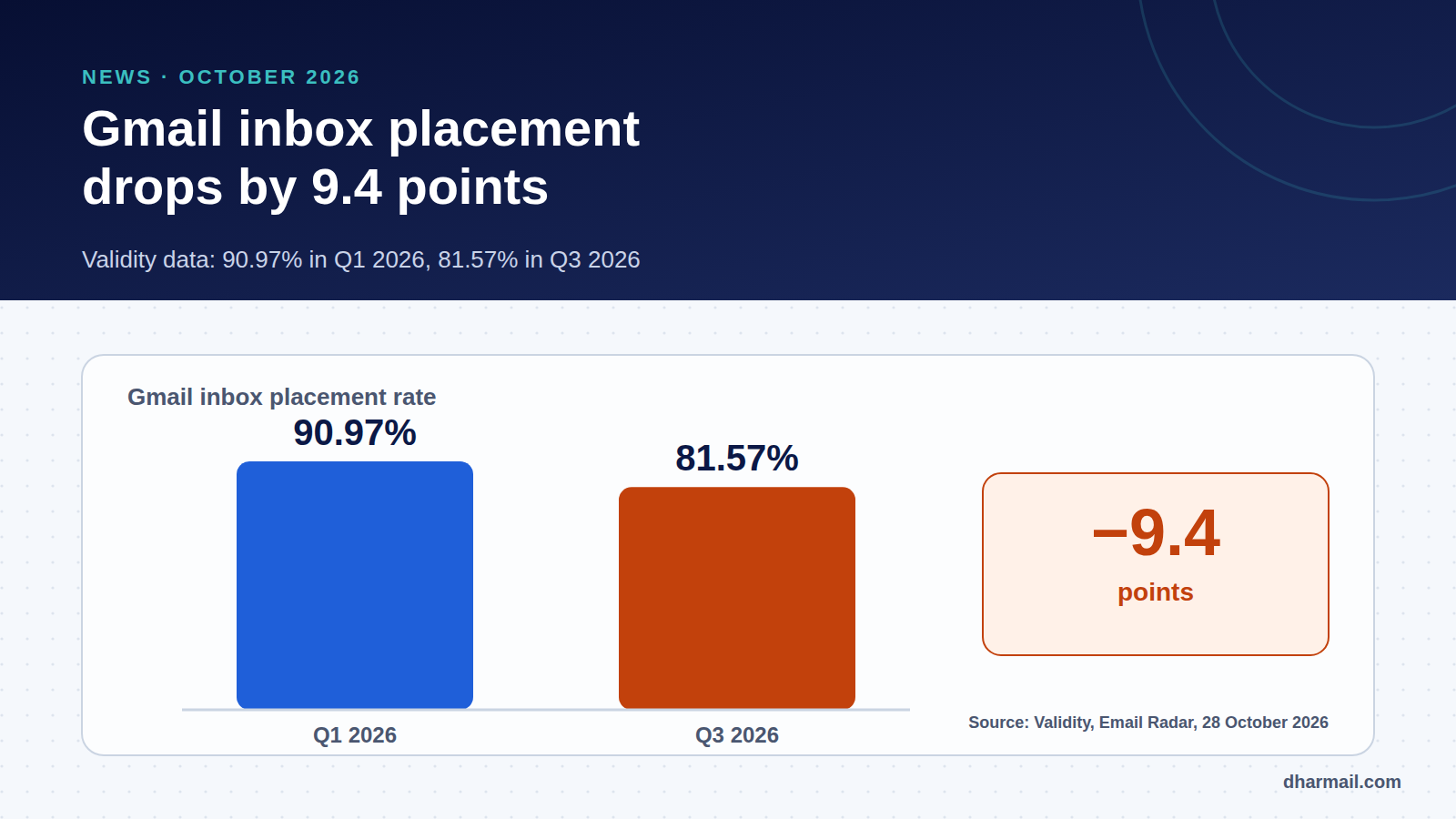
On 28 October 2026, Validity published a figure that got the whole industry talking: Gmail inbox placement fell from 90.97% in the first quarter of 2026 to 81.57% in the third. Nearly one email in five sent to Gmail no longer reaches the inbox. A few weeks before Black Friday, this is not an abstract question.
The drop does not hit every sender the same way. It mainly affects those who do not fully meet Gmail’s rules. Here is what the data shows, what it does not, and the checks to run now to protect your email deliverability.
Key takeaway: according to Validity, Gmail now fully enforces its 2024 requirements (authentication, one-click unsubscribe, complaint rate). Compliant senders with clean lists are barely affected. Check your signals in Google Postmaster Tools before your year-end campaigns.
What the figures show
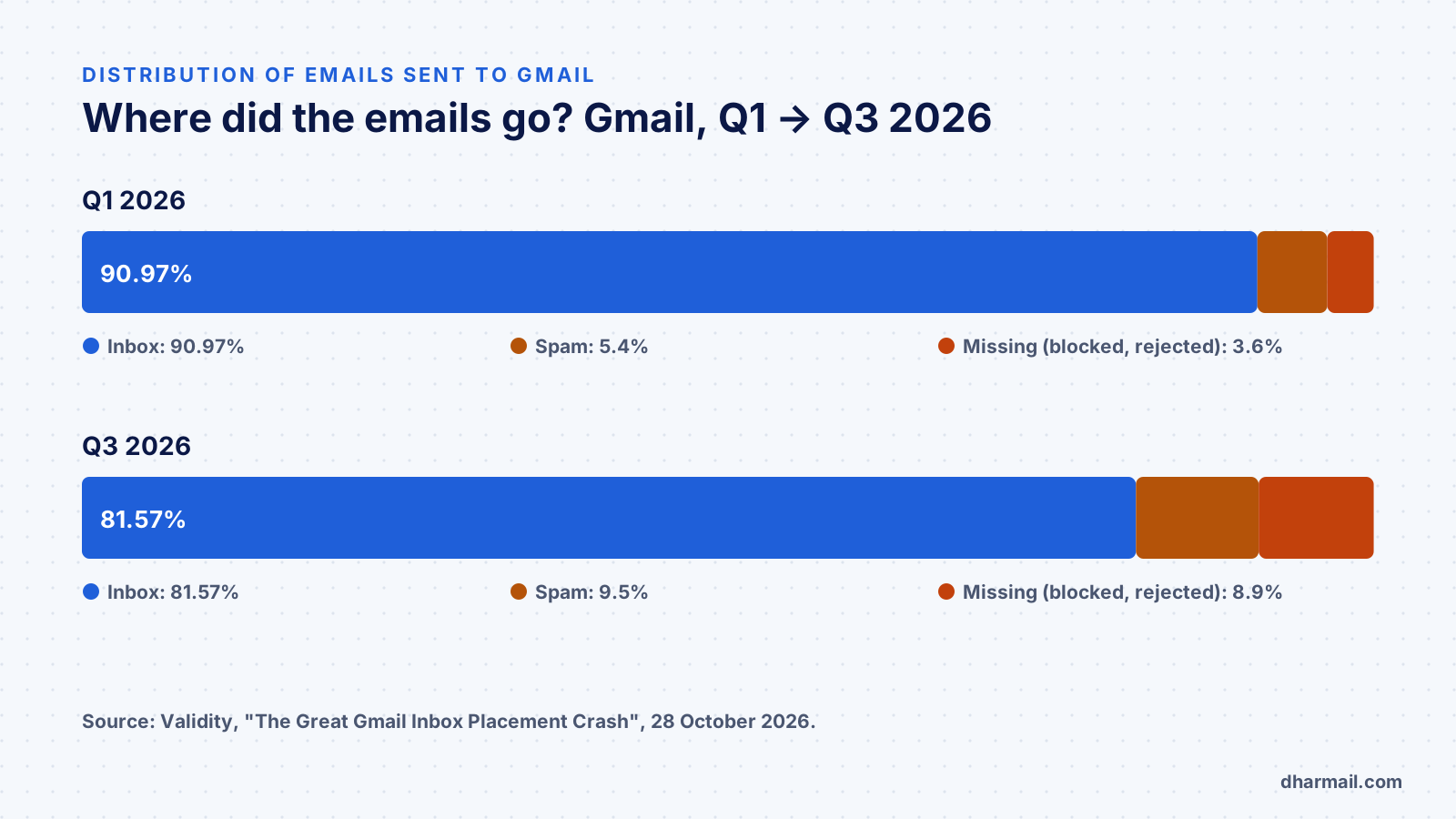
Validity, a deliverability specialist, compares several Gmail indicators between the first and third quarters of 2026:
| Gmail indicator | Q1 2026 | Q3 2026 |
|---|---|---|
| Inbox | 90.97% | 81.57% |
| Spam folder | 5.4% | 9.5% |
| Missing emails (blocked or rejected) | 3.6% | 8.9% |
The inbox decline reaches 9.4 points. Validity speaks of a “9.4 percent reduction”; it is in fact percentage points. The most telling detail is elsewhere: the share of missing emails, meaning blocked or rejected before even reaching the spam folder, more than doubled.
Validity also mentions a decline for Google Workspace, from 88.9% to 74.3%, without stating the exact comparison period. For context, its 2025 benchmark put inbox placement at 89.8% for Gmail, 87.3% for Yahoo and 77.4% for Microsoft.
What the figures do not say
Validity’s post does not detail its methodology: sample size, type of measurement, exact coverage of the third quarter. It is an average across the senders it follows, not a measurement of your domain. Validity itself notes that senders with clean lists often see little change. These figures are a warning sign, to be compared with your own data.
The three causes Validity points to
1. Full enforcement of the 2024 rules. The requirements Gmail announced for bulk senders (aligned SPF, DKIM and DMARC authentication, one-click unsubscribe, low complaint rate) are now fully enforced, according to Validity. Non-compliant messages go to spam or are rejected. Our article on DMARC requirements at Gmail, Microsoft and Yahoo details these rules.
2. A relevance-sorted Promotions tab. Gmail now ranks some promotional messages by relevance and adds automatic annotations. Less engaging messages become less visible, which reduces engagement and then weighs on reputation.
3. Artificial intelligence in the inbox. Automatic summaries and assistants reduce human interactions with emails. Fewer opens and clicks mean fewer positive signals for the sender. Our analysis of Gmail AI Inbox covers this point.
What is at stake for Black Friday
Validity estimates the average value of an email at 11 US cents. With 9.4 fewer points of placement, that represents about $5,500 in lost revenue per million emails sent to Gmail during Black Friday. Gmail accounts for 40.4% of mailboxes worldwide, again according to Validity.
The calculation is an estimate, but the order of magnitude justifies checking your setup before year-end campaigns, not after.
Checks to run now
1. Open Google Postmaster Tools
It is the only source showing how Gmail sees your domain: complaint rate, compliance status with sender requirements, authentication errors. If you have not set it up, our guide to setting up Google Postmaster Tools takes a few minutes.
2. Check authentication on real messages
Correct DNS is not enough: every sending tool must produce messages that pass DMARC through aligned SPF or DKIM. Open the original of a campaign received in Gmail and look for dmarc=pass. A broken SPF record easily goes unnoticed, as our SPF permerror case study shows.
3. Check one-click unsubscribe
For bulk marketing, the List-Unsubscribe and List-Unsubscribe-Post headers must be present and covered by DKIM, and unsubscribes must be processed within two days.
4. Watch the complaint rate
Google asks senders to stay below 0.1% and never reach 0.3%. See the impact of the Gmail spam complaint rate.
5. Clean and segment before the peak
Remove hard bounces, set aside long-inactive contacts and do not ramp volumes up abruptly. A sending spike to a degraded list is the classic recipe for a failed year end. See B2B list quality.
6. Check blocklists
A rise in “missing” emails can also come from a block. Our guide to email blocklists explains how to check your IPs and domains.
FAQ
Has Gmail deliverability really dropped for everyone?
No. Validity’s figures are an average. Compliant senders with clean lists are generally barely affected.
How do I know whether my domain is affected?
Check Google Postmaster Tools, verify authentication on your real messages and compare your open and bounce rates at Gmail with other providers.
Why are more emails “missing”?
These are messages blocked or rejected before reaching the inbox or spam folder, typically because of failed authentication or insufficient reputation.
Is the Promotions tab a problem?
It is not spam, but relevance sorting makes less engaging messages less visible, which reduces positive signals. See why emails land in spam or Gmail Promotions.
What should I prioritise before Black Friday?
Check Postmaster Tools, aligned authentication for every tool, one-click unsubscribe and list hygiene, then send gradually.
Conclusion
The drop measured by Validity does not point to a mysterious new filter, but to strict enforcement of rules known since 2024. That is good news for rigorous senders and a warning for the others. Before year-end campaigns, take an hour to check your Gmail signals. If the results worry you, Dharmail’s email deliverability audit (page in French) identifies the causes and priority fixes.