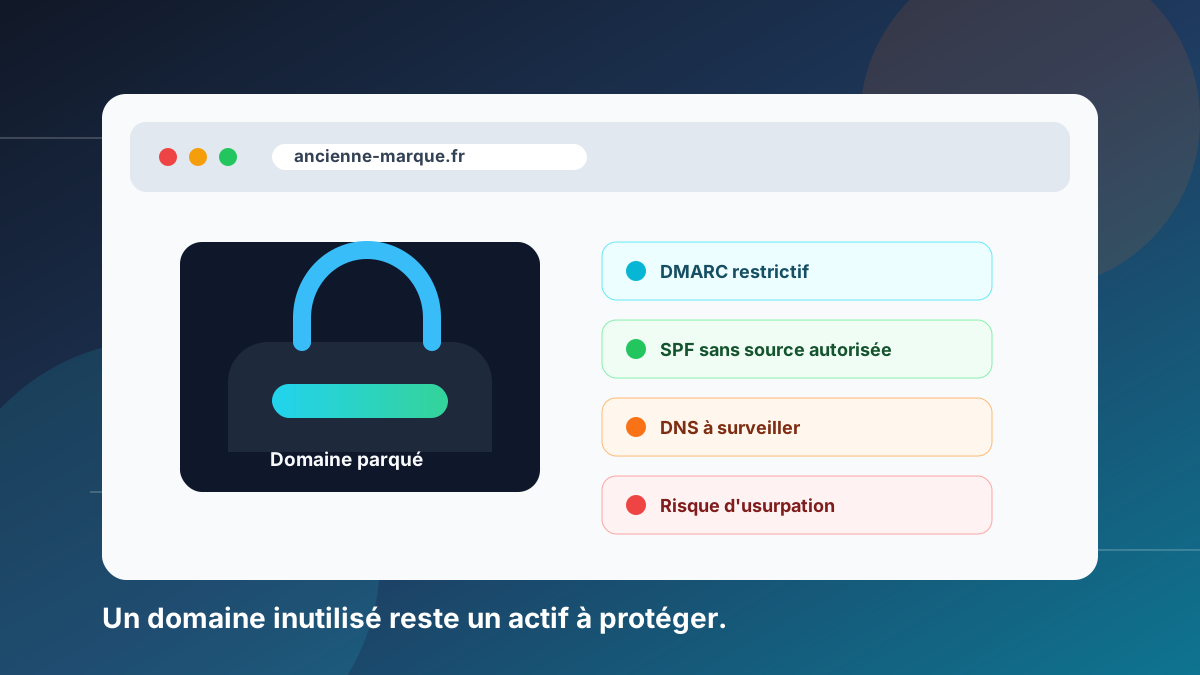
A parked domain is not necessarily an inactive domain.
Many companies own domain names bought “just in case”: old projects, brand variants, defensive domains, names never really used, or domains kept to prevent cybersquatting.
On paper, these domains seem harmless. They do not host the main website. Teams do not use them. They do not send newsletters. Sometimes nobody even remembers why they were bought.
Yet a forgotten domain can become a real email and security risk.
An unused domain is still a digital asset
A domain name belongs to the company. Even if it sits idle at a registrar, it is still linked to the brand, its history, its products or its executives.
That is exactly what makes it attractive to an attacker.
A parked domain can look like a legitimate one. It may contain the brand name, a former business line, a spelling variant or a similar extension. For a customer, supplier or employee, the difference can be hard to notice.
An unused domain should therefore not be seen as “empty”. It should be seen as a digital asset to protect, just like a production domain.
The most common risk scenarios
Even if the domain does not send email, it can be exploited in several ways.
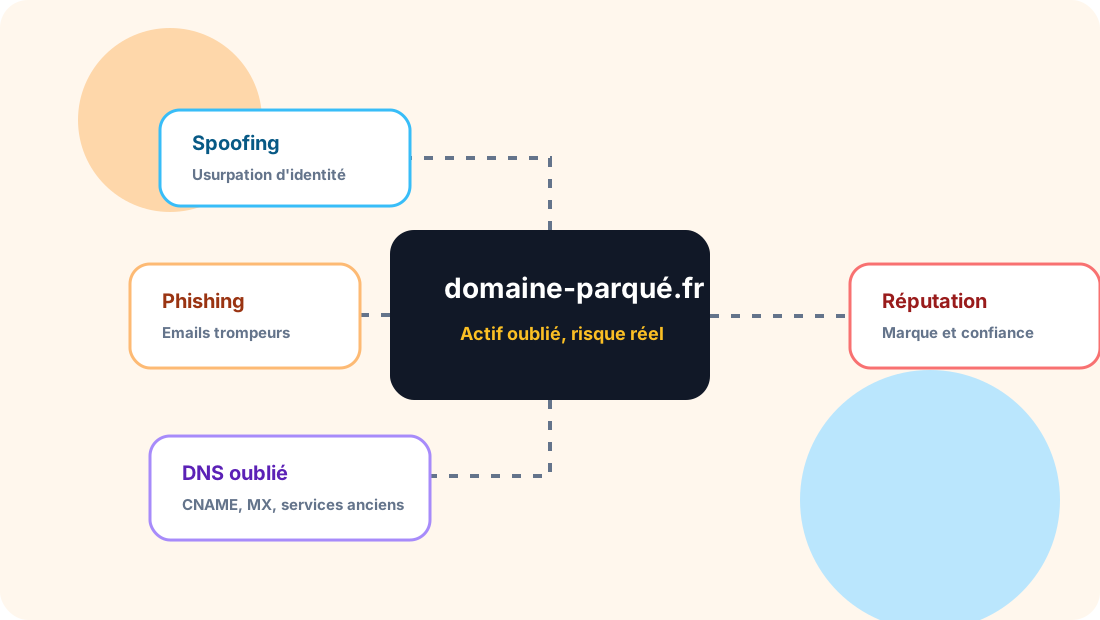
Impersonating the company
An attacker may try to send email using an address on the parked domain. If the domain has no clear SPF, DKIM or DMARC policy, some checks may be weak or ambiguous.
The goal is simple: make people believe the message comes from the company.
This can target customers, partners, suppliers or internal teams. Even if the attack fails technically, it can create doubt, waste time and harm reputation.
Phishing and brand confusion
A defensive domain or brand variant can be used to build a phishing page, a fake invoice, a fake support channel or a phishing campaign.
The problem is often psychological: the domain looks close to the real one, so the recipient lowers their guard.
In that context, the parked domain becomes an attack surface. Being unused is not enough. It must also be locked down, monitored and documented.
DNS that was never cleaned up
Old domains sometimes carry traces of past projects:
- an old
CNAMEpointing to a SaaS service; - a leftover
MXrecord; - a TXT record added for a one-off verification;
- a forgotten subdomain;
- a redirect that is no longer needed;
- a DNS delegation to a zone nobody follows anymore.
These leftovers may look harmless, but they sometimes create room for abuse. The risk depends on the context, but the principle is always the same: what is no longer used should be removed or monitored.
The minimum email baseline for a parked domain
An unused domain should not be left without an email policy.
The good practice is to publish records that clearly state the domain is not allowed to send email.
Example of a restrictive SPF record:
v=spf1 -allExample of a protective DMARC record:
_dmarc.example.com. TXT "v=DMARC1; p=reject; rua=mailto:dmarc@example.com"In some cases, it is also worth checking that no sending service is attached. The key point is to make the intent explicit: this domain must not send email.
Checks to run regularly
A parked domain should be monitored like any other digital asset. Not necessarily every day, but often enough to avoid blind spots.
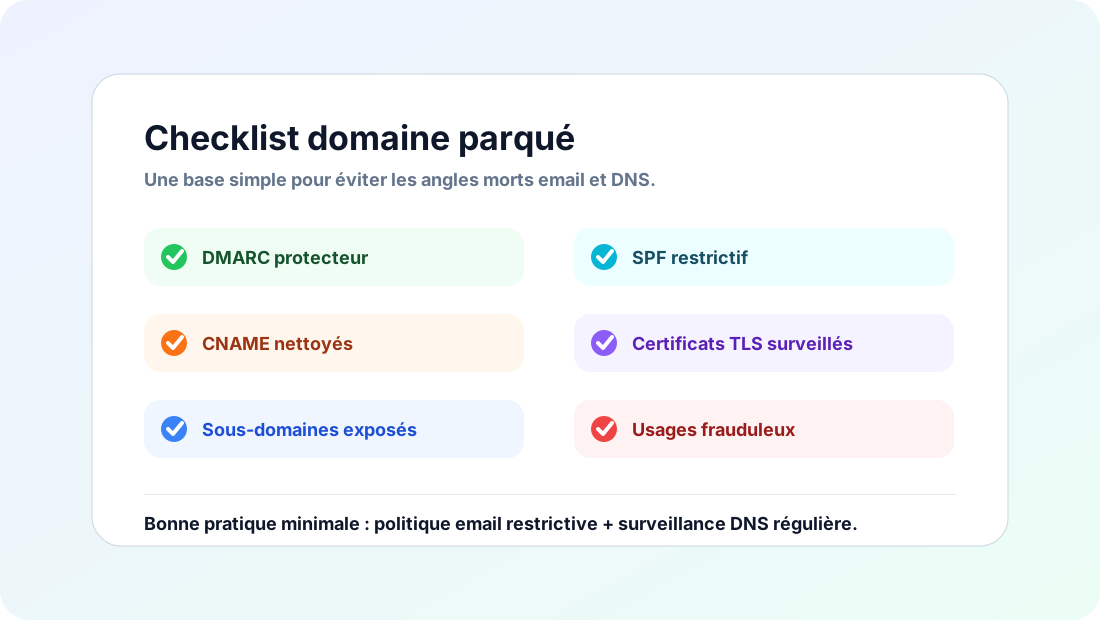
Simple checks to build in:
- confirm a protective DMARC policy is in place;
- set a restrictive SPF record when the domain does not send;
- check that no old
CNAME,MXor forgotten services remain; - monitor TLS certificates issued for the domain;
- check exposed subdomains;
- watch for spoofing attempts or fraudulent use;
- document the internal owner of the domain;
- keep a list of defensive and legacy domains.
Nothing in this list is spectacular. That is precisely what makes it useful. Most avoidable incidents start with a simple item that was never reviewed.
A parked domain does not need to be active to become useful to an attacker.
The link with deliverability
Parked domains are usually seen as a cybersecurity topic. That makes sense, but deliverability is affected too.
Mailbox providers assess the consistency of an email ecosystem: domains, subdomains, authentication, reputation, alignment, history and trust signals.
A misconfigured secondary domain will not necessarily harm the main domain directly. But it can create confusion, enable abuse or weaken the overall perception of the brand.
In email, trust is built through consistency.
Conclusion
A parked domain should not be left “empty”.
The minimum good practice is clear: publish a restrictive email policy, monitor DNS changes and keep visibility on any use of the domain.
In cybersecurity as in email deliverability, blind spots are often the most dangerous. Parked domains are clearly among them.
If you own several domains, Dharmail can help you protect even the ones that send nothing against spoofing (page in French).